
Finding My People
A Reminiscence About Coming Together Around Mastery -- Although Sometimes Mastery Of Complete And Total Nonsense

The ability to come up with total bullshit without even thinking about it, and then to convey that with nonchalant confidence…that to me was what Hampshire College was all about. Deep down, no matter what other lofty notions we may later lard upon our experience, all of us Hampshire grads know that.
It’s our superpower.
“Finding your people” is not a phrase that I grew up with. But it’s one that I’ve encountered and thought about with increasing frequency as of late.
Each Summer for the past several years, I head out on a 400 mile organized bike trip along the Erie Canal. The trip attracts hundreds of riders who spend a week biking, camping, eating and partying as only a bunch of people whose average age is roughly 60 can do along the beautiful historic bikeway. The first year I went, I recall checking in with home someway along the trip and enthusing about how much fun I was having. My wife responded by noting that I had clearly “found my people” among the participants. She, of course, was correct…and since then, I have been particularly reflective about those situations where I encounter my people (whether or not they’re on bikes, sweating and covered with stone dust).
This is a story about a much earlier experience of finding my people and by the way of telling that story, maybe a few thoughts that come to mind when contemplating the sad collapse of my alma mater, Hampshire College.
I should begin by noting that this whole idea of finding my people is not something that comes lightly or naturally for me. I grew up in a family that not only had no “your people” but worked diligently to distance itself from any likely candidates should they somehow manage to appear. Doubling down, we largely defined ourselves by being in opposition to whatever and whoever was outside the household at any given time. Our policy was anti-people.
Still, not everyone in that family shared quite the same perspective, and at least one of us (i.e., me) always felt a bit mystified as to how come we never had any friends, extended family, or what one might now think of as a tribe of “our people”.
Answering that question about my birth family, or even speculating an answer, would take more time than we have here today, so let’s just leave with an analogy that says that the character on The Munsters who seemed most relatable to me was Marilyn. A lot of my childhood seemed like straddling the fictional worlds of Westbury College and whatever weirdness was going on with Herman, Lily and Grandpa at 1313 Mockingbird Lane. But kids being kids, I really didn’t question why our family had no tribe until nearly the time I grew up and was out of the house.
Whereupon, a somewhat circuitous late adolescent search for my people ensued.
My First Mistake
My first stop on this journey was a college that we don’t need to spend much time with other than to say that it very quickly turned out not to harbor my people. Since I hadn’t yet articulated the “my people” concept, at the time I simply summed things up by saying that it sucked.
Adding to my misery was that the College - Emory - was in Atlanta, Georgia…a place that I’d visited only a few times before with my family on vacation. Back then, in the 1960s, my dad was an urban planner and therefore went to a lot of conferences in places that were always on the verge of tearing everything down and rebuilding entirely anew (history says that bonus points were awarded for concurrently finding ways to throw out all of the poor people and minorities in the process). Atlanta was one such place. Plus it had a big new airport. Airports and the construction of new highways that led to them also figured large in my dad’s professional interests…I knew much more about the Dulles Access Road - and Reston, VA - as a 2nd grader than most people my age. Fact. Regardless, none of this prior experience going on various business trips with my dad, qualified me to actually relocate to Atlanta, and in fact I had never considered doing so, until I did when I graduated high school in 1979.
On the ground, in Atlanta, in the Fall of 1979, I quickly realized that I’d made a huge mistake. That realization inspired me to take uncharacteristically fast action. Not only did I at least temporarily abandon the pre-med track I had entered with (and had focused my application around) but I instead signed up for a rich diet of seminars on Southern Writers (hence the name of this Substack), philosophy and film. And as one might imagine, that was a self-realization road to ruin which soon had me deciding to go find another place to go to college. One where there were more than a handful of humanities courses in the catalog and one where not everyone around me was only focused on what they “needed” to do in order to get into medical or dental school.
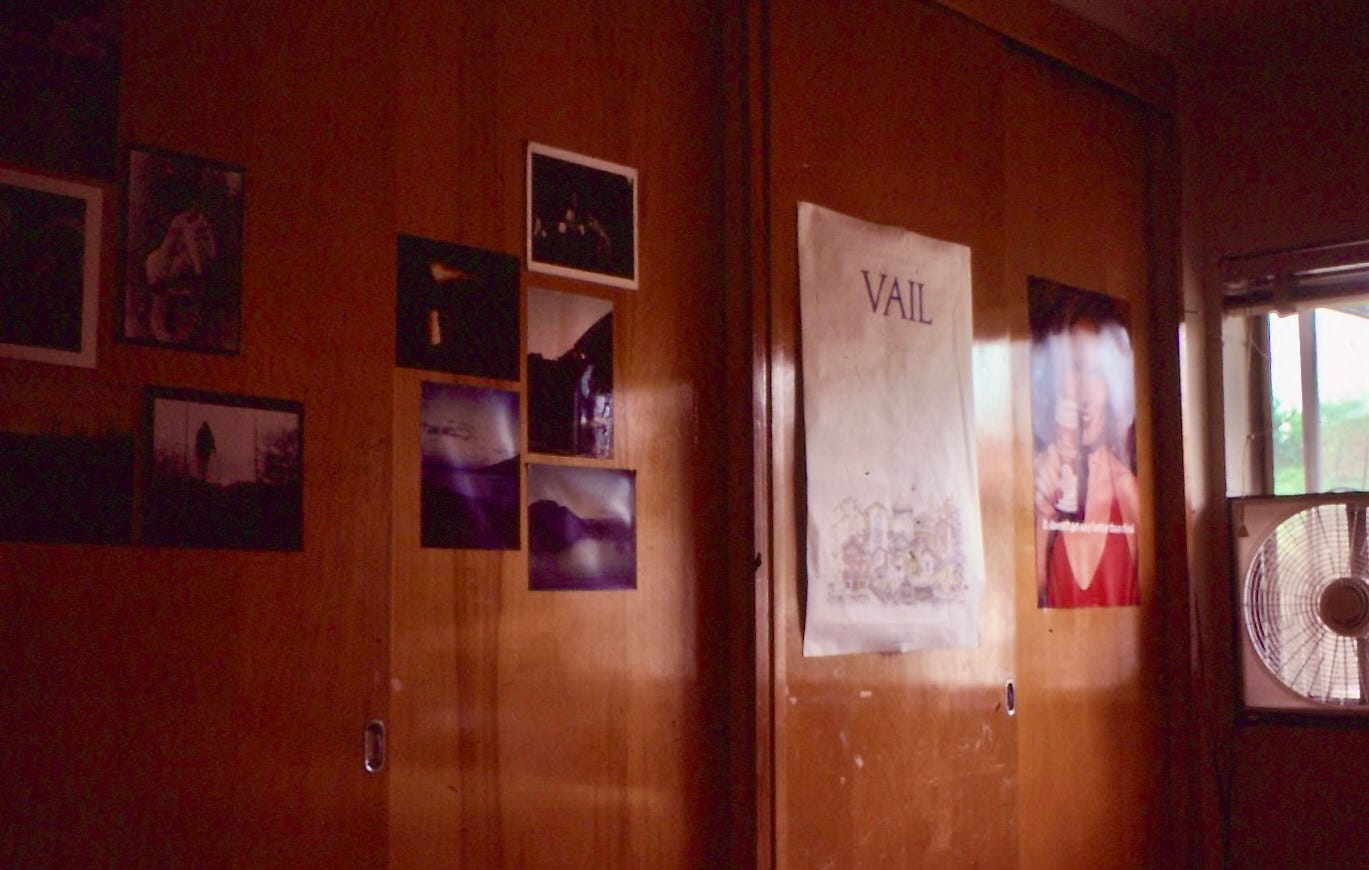
There Are Few Mistakes That Cannot Be Addressed By Just Driving Away
That’s how I wound up in New England. The primary qualification for Massachusetts or thereabouts was that it wasn’t the South and seemed to be a part of the country where finding ways to pave pretty much everything and fill in the rest with colored mulch was not Civic Job 1. Without much more criteria than that, Hampshire College came onto my radar.
Full disclosure, I did have a high school friend who was attending Hampshire. Furthermore, it was a short drive (for a guy who’s always enjoyed driving) from another close friend at Williams College, one at Cornell, and several more at Columbia in NYC. All in all, a relocation to Massachusetts would be much better than Atlanta where I - even though I wasn’t using the term at the time - had no people and was physically and culturally worlds away from the Northeast.
In the Spring of 1980, I broke it to my parents that I was not going to continue at Emory and asked my dad to go with me to Hampshire during Emory’s ridiculously early Spring Break to check it out. (I didn’t want to miss James Dickey’s guest lecture in my Souther Writer’s course.) Basically I really could not believe that my dad would just start writing checks to a different place with no questions.
A campus visit with a parent was not something I’d done at Emory. There, I’d simply signed up for school, and told him about it. His response about Emory was “Ok”; which is kind of about all most kids back then could expect of their parents’ engagement around things like college choice (or most anything else their kids were up to). My dad had no expectations one way or another about where I might go to college as he was a well-educated refugee and was happy that I didn’t need to clamber onto a boat with only whatever I could carry in my pockets like he did to escape a country that was literally burning down behind him….something that he constantly warned could very likely be necessary for me to do “someday”.
This may be yet another thing, 50 years later, that I realize that he may have been right about.
Still, at the time I was sufficiently worried that he may put the kibosh on my intended actions related to what he would have deemed to be petty concerns about Emory. (In my dad’s world view, there was “the imminent collapse of civilization” and then everything else…all of which pretty much took a back seat to escaping armed conflict.) I therefore did all I could to build my case for transferring, even going so far as to apply for financial aid to cover the considerable price difference between Emory and Hampshire. I’m not sure this helped grease the skids for me with him, but it did ultimately result in my qualifying for a number of campus work study jobs at Hampshire which were quite beneficial to me and the search for my people.
We had a great road trip between Maryland and Amherst, MA…my first of literally hundreds of subsequent trips I’ve made along that exact route over the past nearly 50 years. I can’t remember what he thought of the campus, but he’d spent a considerably amount of time in his mid-20s as a new immigrant in a nearby part of Massachusetts, so he was positively inclined to the place, and that seemed good enough. The college - while not exactly winning his blessing - didn’t offend him, and so he went along with my decision to attend.
“Went along” is about right. I recall him picking up a piece of admissions literature while we were on campus that highlighted what current students were studying. One of the featured stories was about some student who was spending a year in Nepal or Tibet learning to be a yak herder. This factoid amused, but mostly annoyed, him. For the rest of his life (that’d be another dozen years or so) he’d ask me during those times when he frequently felt the need to question my post-Hampshire life choices, how anyone could be “stupid enough” to waste an expensive college education on learning how to herd yaks…something that he pointed out that any illiterate farmer in his native pre-revolution China would likely know how to do.
For my part, I never had a good response to that challenge. And I still don’t.
Admissions
The specific process at the time for getting into Hampshire largely consisted of demonstrating sufficient interest by filling out and mailing in the admissions application. I later learned when I worked in the Admissions department that mailing - while suggested - wasn’t entirely necessary. It was perfectly acceptable to just fill out the form during your on-campus visit and drop it off on the way out the door. Sometimes prospectives would do it in the lobby of the Admissions Office (we had pens…), shortly before they received their interview. Sometimes that interview was from a current student.
In 1980 - 1981 I was one of those current students conducting interviews and reviewing applications, although that practice was absolutely stopped during the time that I worked there.
Before getting any further into this story, I will swear that this change in policy had nothing (specifically) to do with anything that I did. This is despite the fact that the business about touring parents through the shared co-ed bathrooms that connected hallways in the dorms (I always knocked first and loudly announced “Admissions tour, comin’ through!") was definitely frowned upon by the administration. “Frowned upon”. So, yeah, we were pretty much good to go with whatever we wanted to do. In my day, there was nothing more motivating to a Hampshire student than being told that they should not do something.
It’s in the genes. Or at least it was in the genes.
Shortly after I became a student, the college urgently started to de-emphasize the yak herding thing in its promotional materials.
I suspect that one of the reasons why I was selected to be an Admissions Intern (which is what those of us who worked in the Admissions office as work study were called) was that I had come to Hampshire professing to be pre-med. Until and unless you experienced the calming effect on prospective students’ parents that getting a campus tour from a Hampshire student who was a) “majoring” in something conventionally-relatable like pre-med, b) generally wearing shoes, and c) wasn’t (visibly) on drugs could have, you have no idea of the currency that “pre-med” at Hampshire had in the Admissions program at that time.
It turns out that all three of those things about me, their tour guide, could be open for debate if not classified as an outright falsehood. But at the time that wasn’t important. Instead, things nearly always worked out well on my given tours as the prospective students breathed a sigh of relief at the unexpected prospect that their parents might now allow them to apply to Hampshire versus their having to go to Amherst or Smith (as these parents were often alums of either of those neighboring institutions, and these connections were what brought the families to the Valley). And the parents’ concerns were at least temporarily assuaged by realizing that the college wasn’t entirely (we had established plausible deniability which was good enough) the den of iniquity that they had heard about.
I’m sure that I helped inspire quite a few lively family discussions on drives leaving Amherst, headed back to wherever.
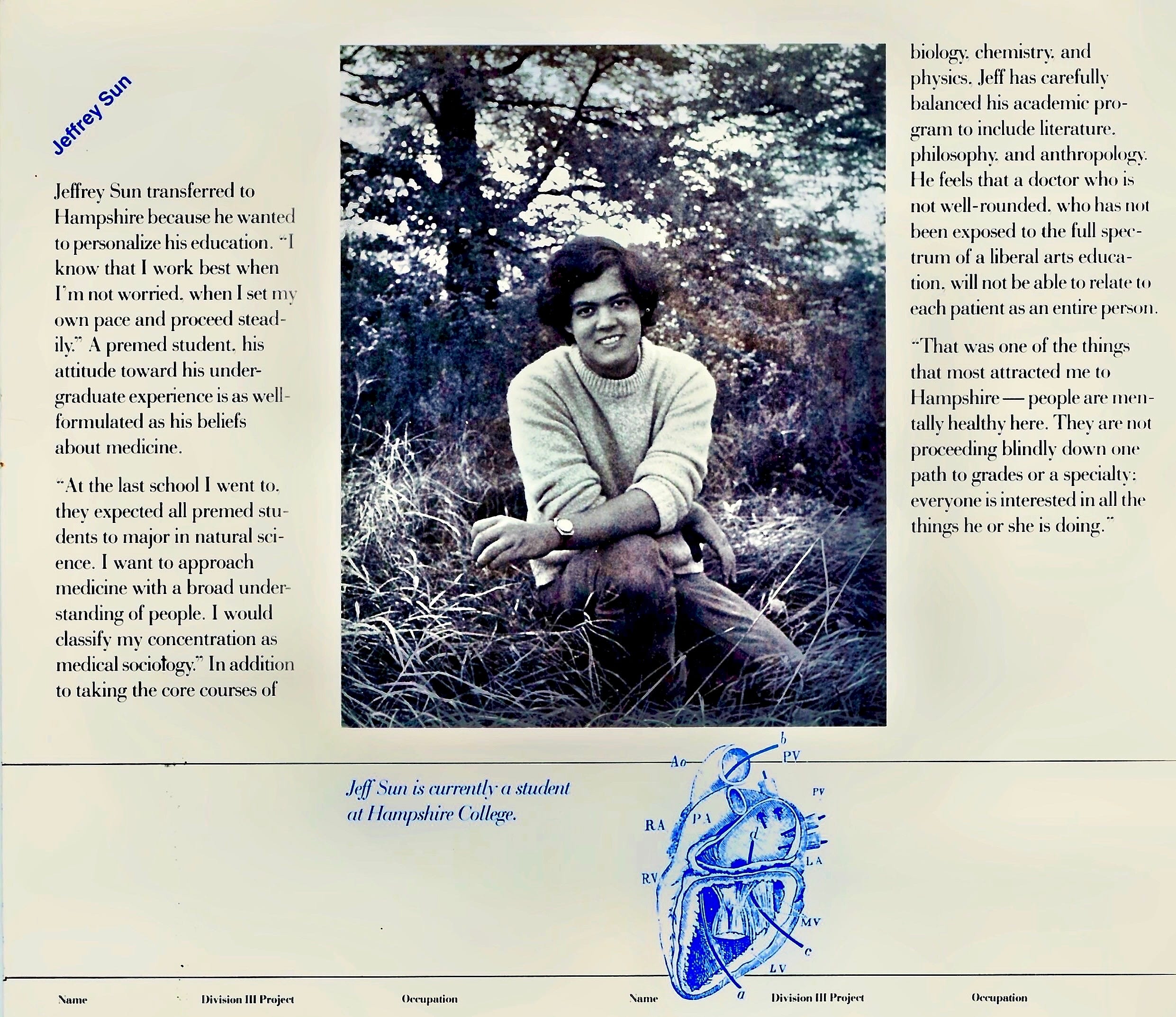
Even by the early 1980s, the times they were a changing. The admissions brochure that described “Jeffrey Sun” featured alumnae spotlights on two lawyers, a research scientist, a playwright, and someone who was starting to make it big in the “new” field of electronic music composition. This was an early milepost in Hampshire’s increasing need to start rationalizing itself to a real-world marketplace where being free to be, you and me, was no longer sufficient…or free (or anywhere close to it). That process of attempted legitimization would continue in fits and starts (but Hampshire being Hampshire, mostly fits) for the next 40-some years. Until it all ended this past April.
Better Living Through Groceries, And A Really Big Car
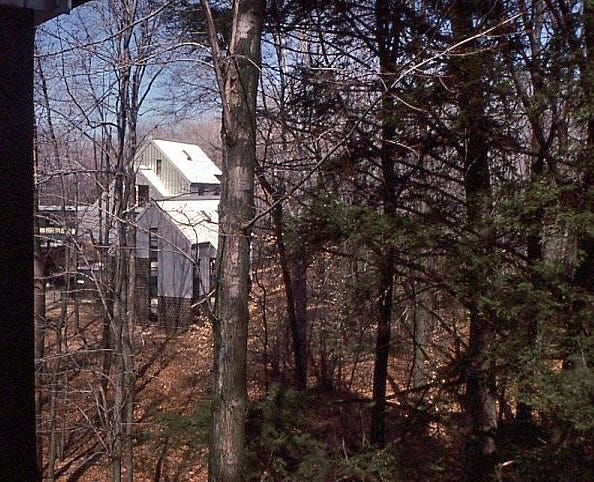
Hampshire had two types of housing for students. One type was conventional dorms. I don’t have much to say about those since I didn’t live in the dorms, and aside from the fact that they mostly had those gender-neutral communal bathrooms - something quite uncommon in 1980 - they were rather unremarkable.
The other type of housing was what were called “mods”…short for “modular units” (which should have been enough to tip us off that they were probably never intended to be permanent buildings…something that has indeed come to pass). Mods were sort of like apartment suites where six to eight students would have bedrooms that shared a common bathroom, living room, and a fully equipped kitchen. This kind of arrangement is common nowadays, but again, in 1980 it was unusual, at least for undergrads.
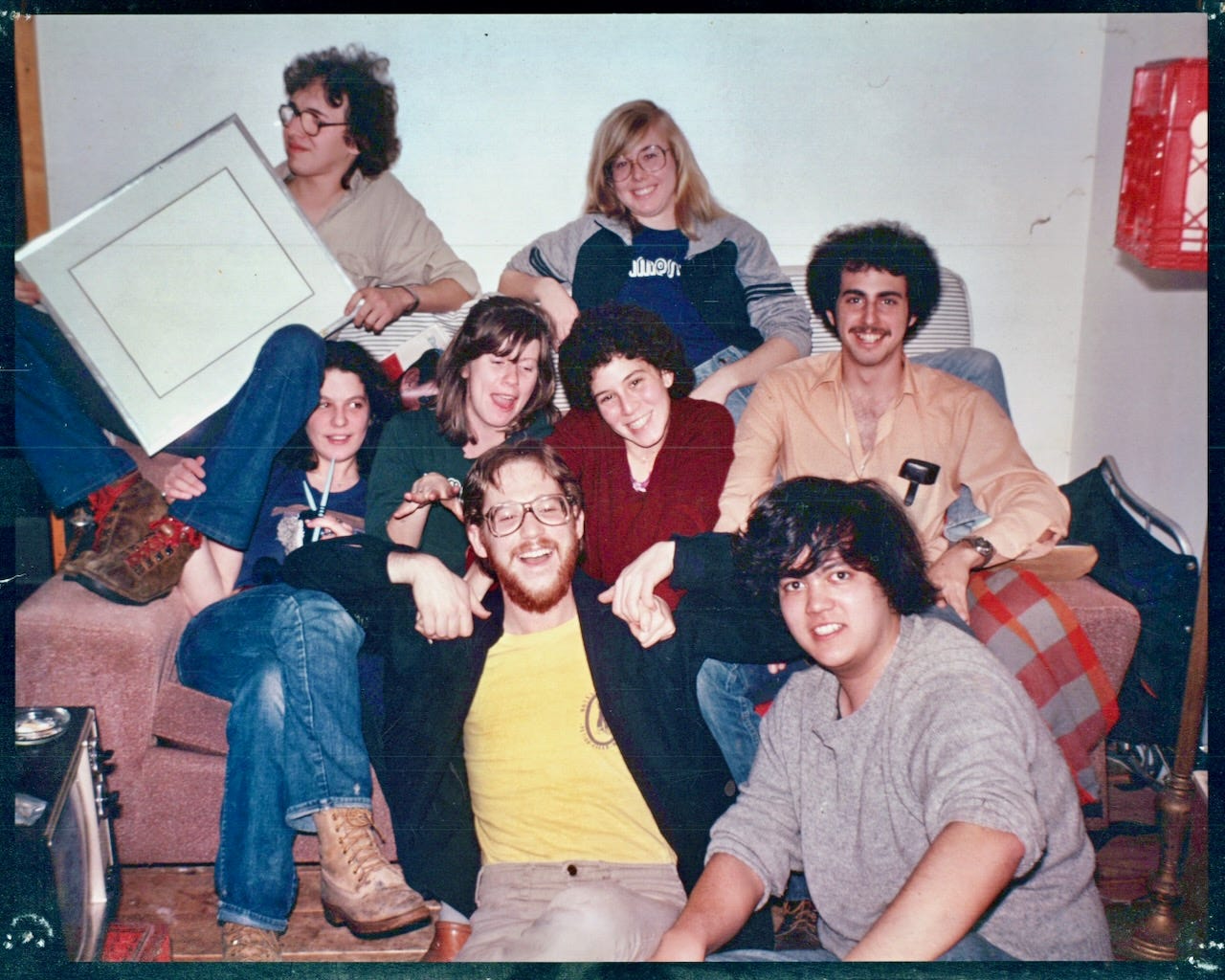
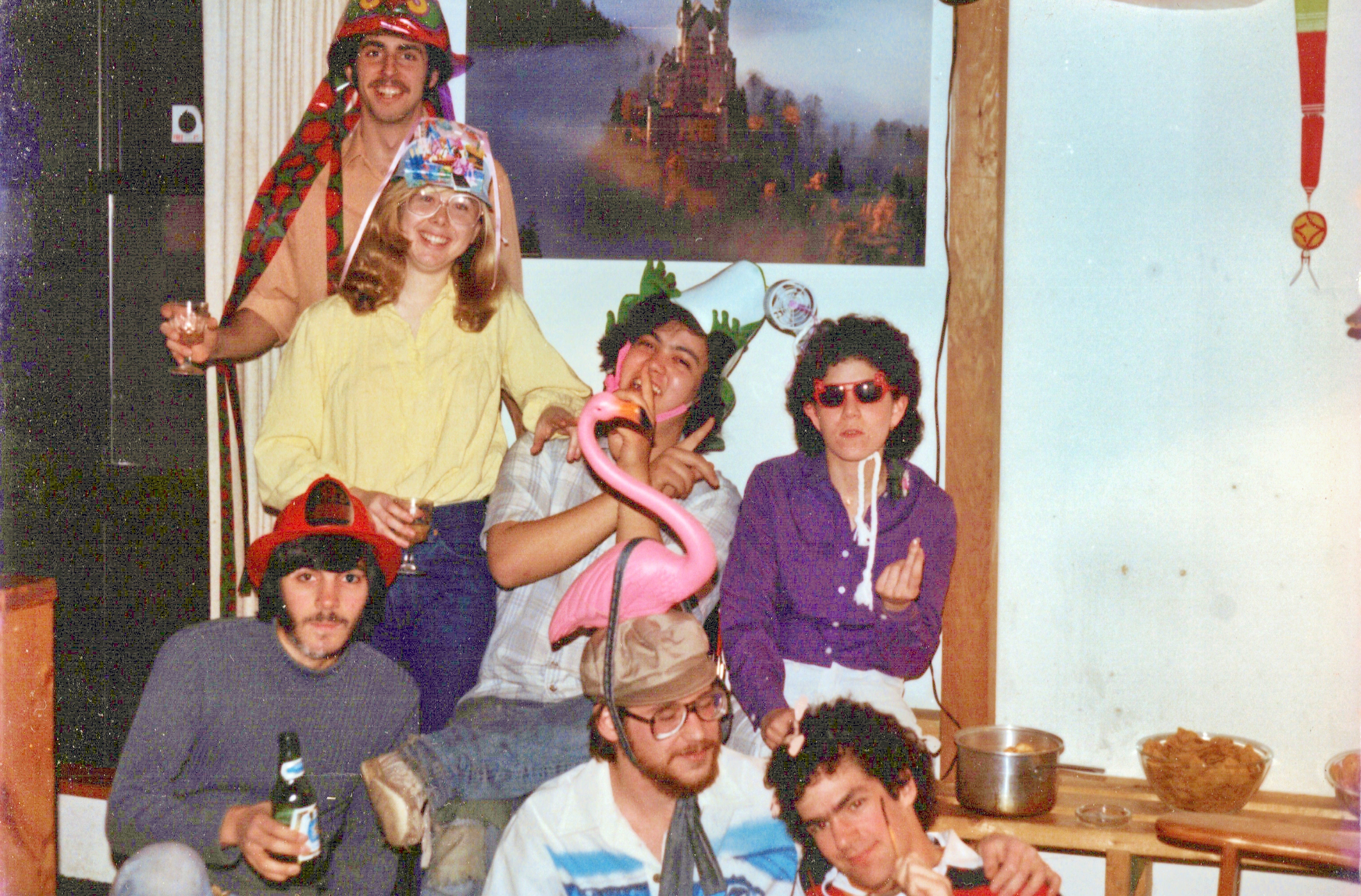
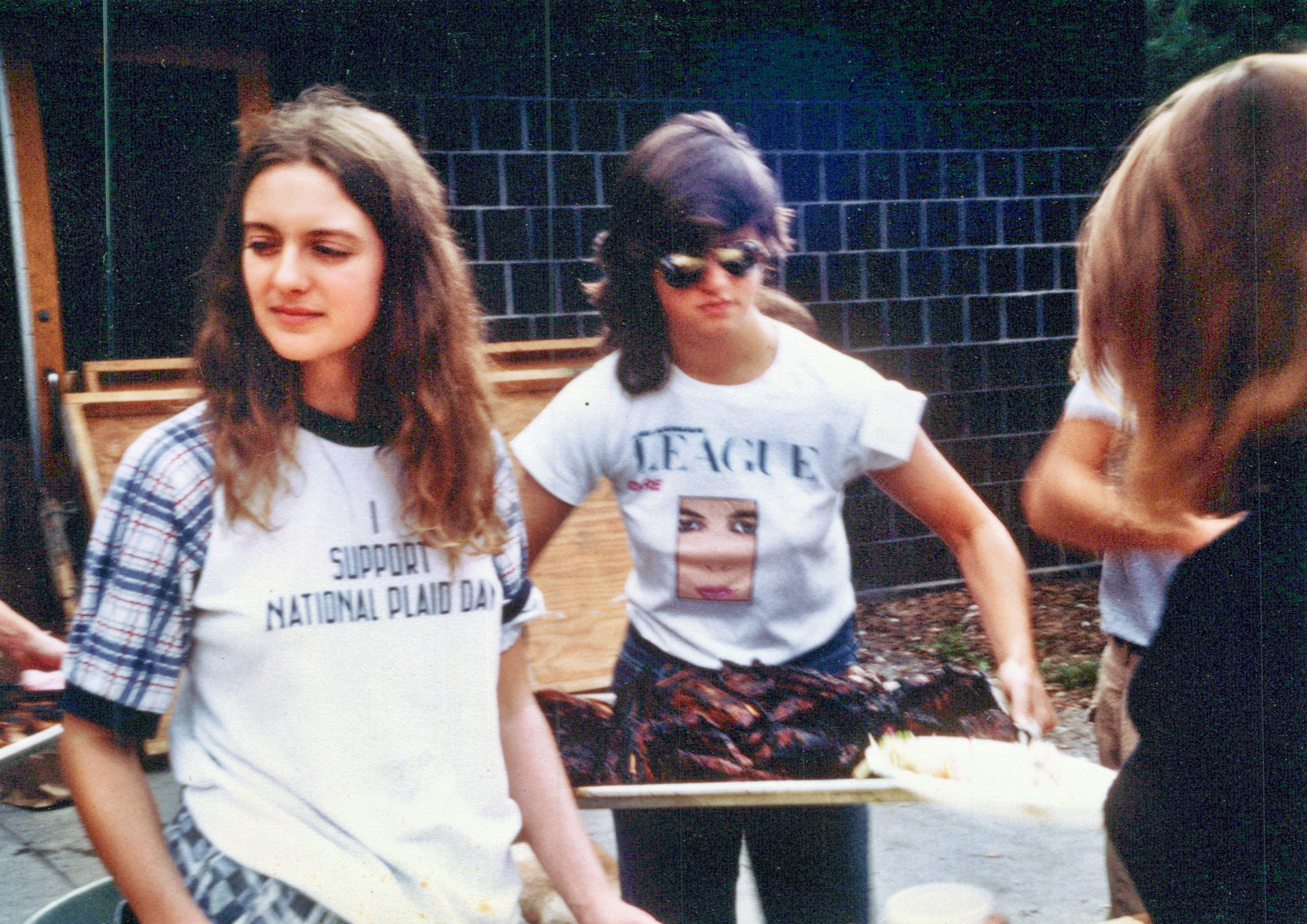
Upon my arrival in the Fall of 1980, I wound up being assigned to live in a mod. With the people in the photo above. The only thing we ostensibly had in common was the fact that we were nearly all transfers or “older” first year students.
The intent of mod living was that the students sharing the mod would live sort of like a family…sharing cooking and cleaning tasks. There was no custodial staff, something that was definitely a problem in some mods. You could live in a mod and still sign up to eat in the dining commons, but in my experience relatively few students did. I maybe ate in the dining commons three or four times total for the three years while I was at Hampshire. This shouldn’t be surprising for the guy who bailed from the Emory meal plan (and successfully petitioned for a refund that they didn’t want to issue on the unused balance) after the first quarter. After that, I cooked for myself at Emory in a toaster oven, hot pot, and on the two burner electric stove down the hall in the common room. Hampshire mod life was definitely movin’ on up on the cooking front.
At Hampshire, the whole point seemed to be cooking as a family. Admittedly in my mod that often turned into “Jeff cooking for everyone.”. I was more than fine with that because there are in fact few things that I’d rather do than cook for a crowd. I’d been doing this since junior high school when my mom - who dutifully fabricated family meals up until I was about 13 - announced that she was done with cooking, and if we wanted to eat, we had best learn how to do it. I was fine with that as well, and I’m happy to report that the Sun family in 1974 quite enjoyed Pizza Hut until I got up to speed in about a year. In short, I took to the whole mod cooking thing quite well…and with few interruptions, this is pretty much how things have gone for the subsequent 46 years.
Although I don’t want to get too far ahead of myself here.
Home/Mod cooking necessitated regular trips to the grocery store; unless you were one of the folks who were doing the pitiful “college vegetarian” thing and you wanted to procure most of your food from the on-campus Co-Op…which had a few good things such as cheese…but otherwise was just a little too crunchy granola for me and my crew. We were transfers, after all, and I frequently enjoyed inviting Co-Op shoppers over for an actual meal every so often that didn’t appear to be cooked by 1970s cultural icon Euell - “Ever Eat a Pine Tree?” -- Gibbons.
Food is where you find it (particularly for followers of Euell Gibbons), but I preferred the grocery store versus a lumber yard.
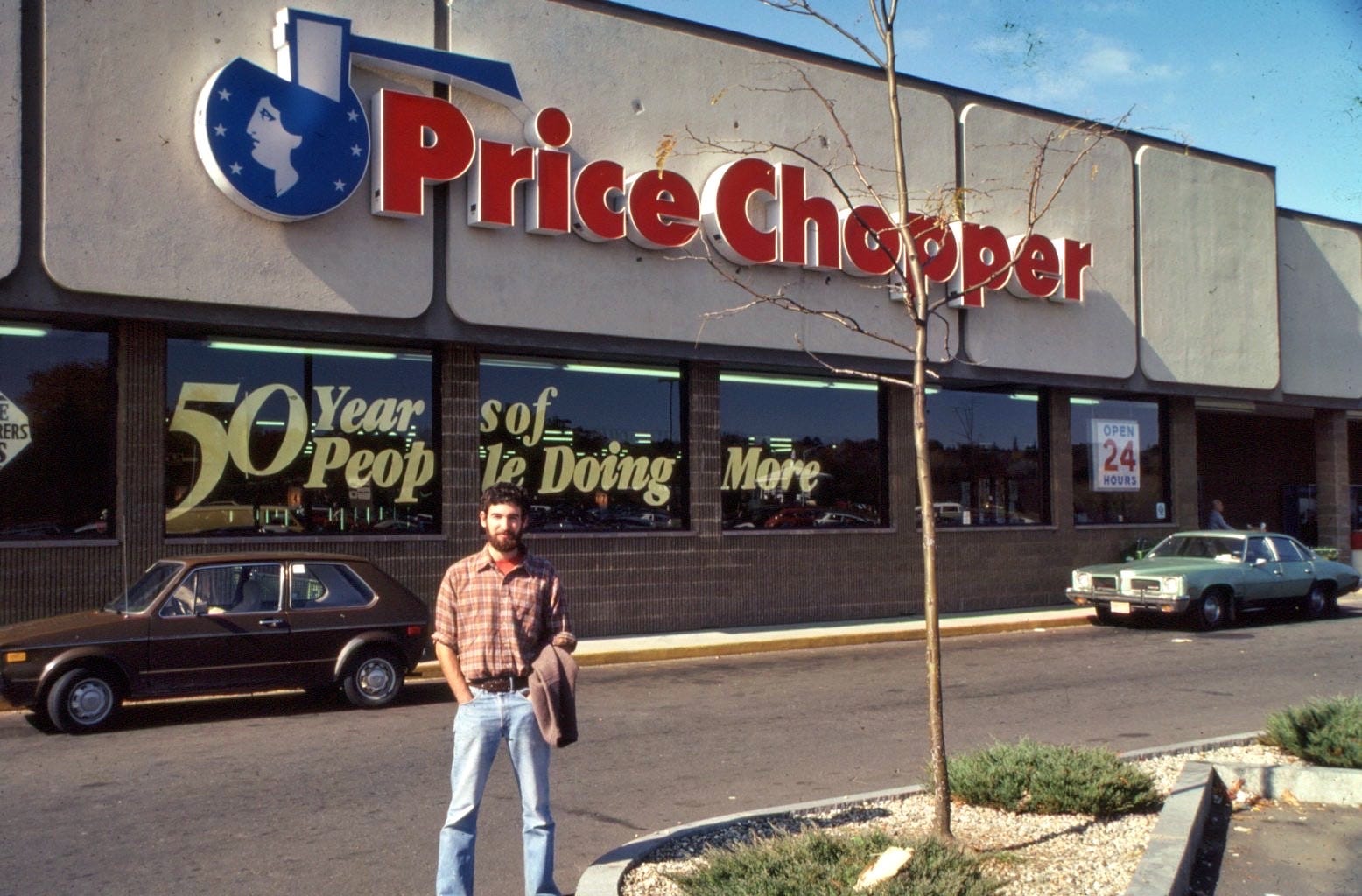
Entering the narrative mix at this point is the fact that I showed up for my first year at Hampshire with a big-ass 1971 Buick. This was a car that my dad had helped me to buy (for $400) half-way through my time at Emory when I was about to lose my mind out of boredom living on campus with no personal transportation. The Buick allowed me to explore all of what I wanted to see within short drives from Atlanta, and when I was done with that, it could take me farther afield. Ultimately it took me to an entirely different part of the country.
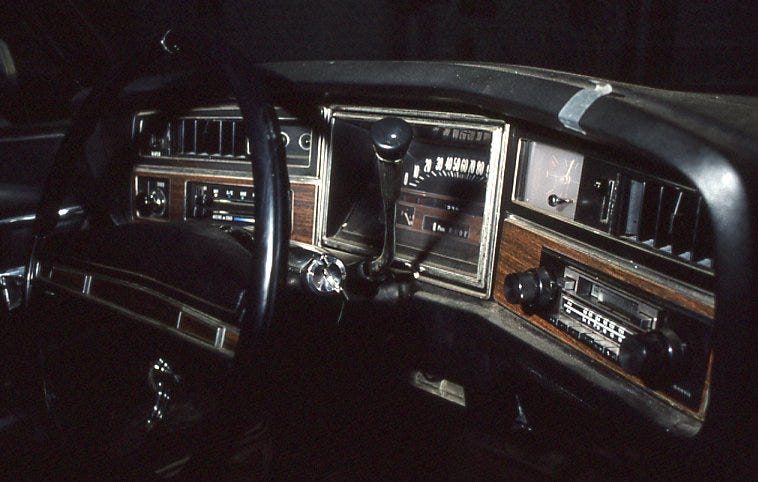
Once the Buick and I arrived at Hampshire, I was initially the only person in my mod that first year who had a car, and certainly the only person who had a car that could hold pretty much everyone in the apartment at the same time. There were eight of us, and generally anytime most of us wanted to go somewhere, we fit in the Buick.
You Know How I Know That?…I Made It Up!
It was the Buick that brought us mod mates early in the Fall of 1980 as newly-minted Hampshire students to downtown Northampton, MA (what passed for a city if you lived in an apple orchard in Amherst, MA) for some kind of exploration or shopping trip.
As we were wandering around, I saw a building that had a sign over the door saying “BPOE” (this anecdote would be so much better if there were a picture, but I’ve already written an entire article about trying to find that nonexistent picture), and naive me says “BPOE? What the hell is that?”
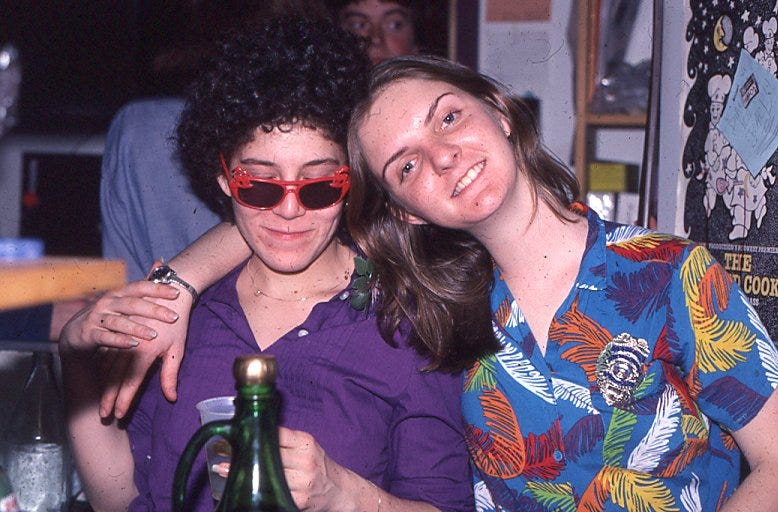
Without missing a beat, Judy (she’s the one on the left with the sunglasses) turns to me and says entirely matter of factly, “Baby Prostitutes of England”, and she then proceeded to continue a conversation with someone else. It took me a moment to realize that she probably wasn’t being truthful (I still had no idea what BPOE stood for); but nevertheless at that moment I came to the realization that hanging with these folks was going to be fun. I had in fact found my people.
Of course, it was more than just the ability to think quickly on one’s feet. It was as much about how this was done. The ability to come up with total bullshit without even thinking about it and then to convey that with nonchalant confidence…that to me was what Hampshire College was all about. That moment on Center Street in NoHo crystalized that for me, early on, then, and eternally thereafter.
Deep down, no matter what other lofty notions we may later lard upon our experience, all of us Hampshire grads know that. It’s our superpower, conveyed upon us by someone. Mostly we aren’t sure by who. It just happened. Despite the fact that some of us insist on attributing this conveyance to one faculty person or another. That too is bullshit, and most of us know it. Nevertheless, we carry our individual nonsense forward into the world until maybe that time when the bullshit becomes real shit. Perhaps because we were born this way and thereby manifest the force of personality to make it that way, or maybe because sometimes this is just what happens eventually when one gets old enough.
Admittedly, a good number of us came to Hampshire with those nascent skills. We honed that talent while there until some (only a bit more than 60% in my day) graduated. Of that I have great confidence. Because I am one of those people, and know those people when I find them, I’m pretty secure in my belief that like me they’re going to be just fine.
The Inevitable Part of Any Article About Hampshire Where We Talk About Ken Burns
Lord knows, all of this had pretty much zero to do with academics, at least in my time on campus. I mean, it could have something to do with classes, if you chose to go to them. But it was entirely possible back then to progress through Hampshire by mostly just having “experiences” (hence the yak herder, who received enough academic credit for that activity to graduate…probably). So long as you spent enough time talking to faculty (there was always someone) about what you intended to do, someday, and in turn got them to sign off on the perceived value of your experiences, you progressed. Eventually. Some people accomplished that through taking courses. Mostly through we engaged in various projects.
For example, four years before I got there, Ken Burns graduated with a project that turned out to be his first film (a film commissioned by nearby Old Sturbridge Village). I completed quite a few Hampshire projects, not surprisingly none of them were as impressive or as generative of future success as Ken’s was. But what my work shared with his was that it was something that I came at the time to deeply care about and was accomplished basically through grit, good luck, and (speaking for myself at least, but I suspect that over beers - which I would gladly pay for - Mr. Burns would agree) a healthy amount of convincingly persuasive bullshit.
As a matter of fact, his faculty consultant (or as we Hampsters would call it, Div III Chair) ultimately worked with several of my mod mates (one of them as her Div III - Chair as well). None of them have become Ken Burns, but that’s not really the point, is it? And if you think that that should be the point, well….Let’s say that you probably wouldn’t have been one of the people who successfully filled out the admissions form and then wound up riding with me in the giant Buick.
I’d have gladly given Ken Burns a ride in the Buick if he’d needed to go to the Price Chopper, but he had already graduated by then (yep, he’s part of the 60%!) and was living up the road a piece working on a film about bridges or something.
Because being a successful Hampshire graduate (or non-graduate, but we still consider them alums if they stuck around for a while before leaving) is not about Hampshire the institution; it’s about the person who may or may not have been positively influenced by some aspect of their experience while passing through. Ken (Sorry…I really don’t know the man and will stop talking about him in a moment; it’s just that he’s the go-to example everyone uses for a Hampshire graduate. It’s a burden he bears nobly.) always had it in him to become the filmmaker who has altered the American media landscape. He just happened as a youth to have wound up at a college that encouraged him versus discouraged him, and surrounded him with people who helped him to exit as a different person than who he was when he went in. That’s what finding your people does. It’s something that it took me a very long time to realize, well after I had come to experience it.
So let’s talk a bit more about the experiencing it part.
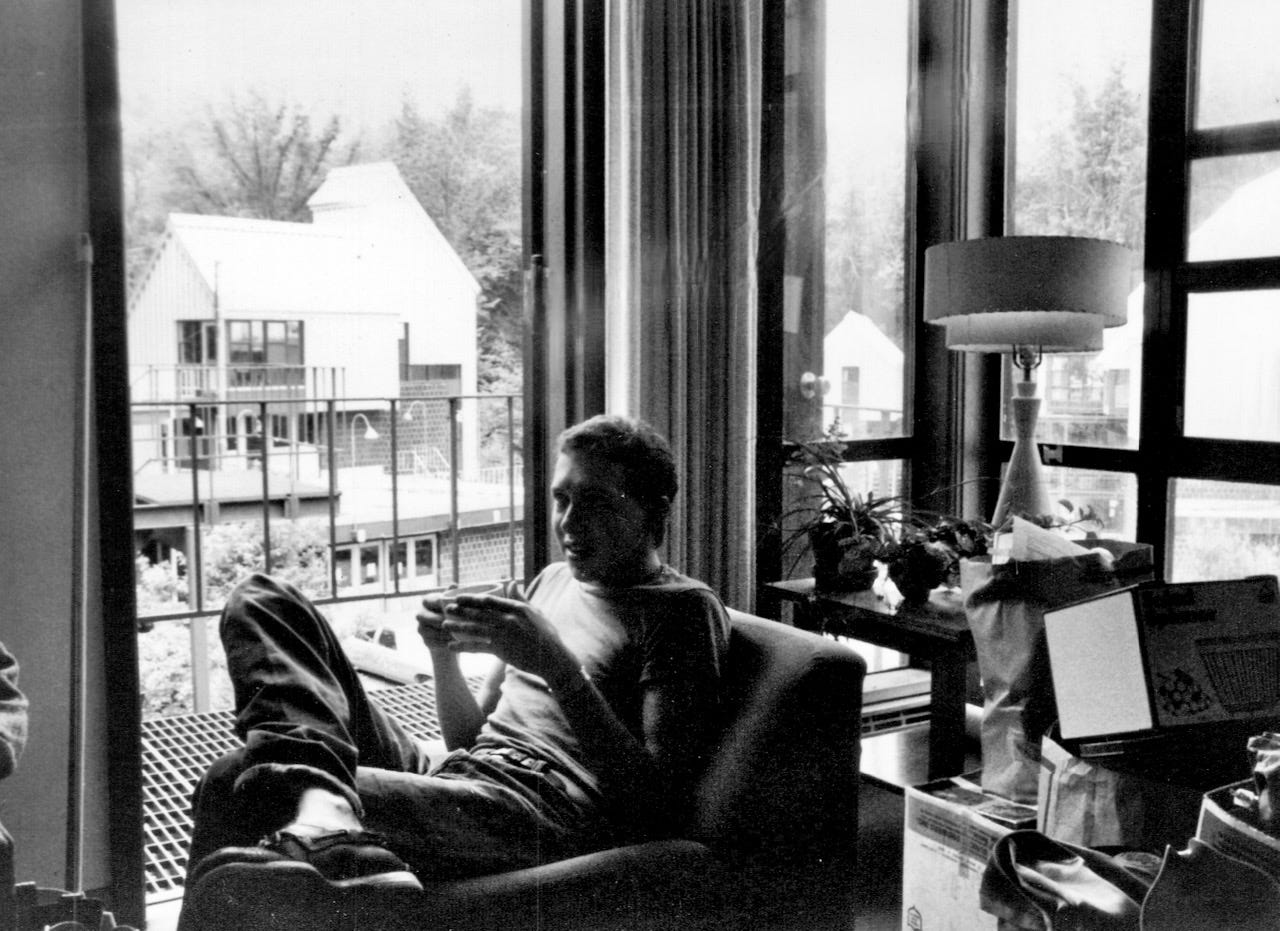
The Best Job That I Ever Paid To Have
I spent my entire time at Hampshire working. Like, working actual campus jobs that I got paid for. This was admittedly a bit of a weird arrangement - my dad was paying something like $8,000/year for me to be there, and yet the school was paying me a wage to spend a considerable amount of my time working for them.
It was the best job that I ever paid to have. And in one form or another constituted most of what I spent my time at Hampshire doing (besides all of the grocery shopping and cooking).
For example, there was the summer that I spent living on campus and alternating between working at “Summer Programs” (which mostly consisted of manual labor and driving a 15 passenger Ford Econoline van delivering privileged senior Boomers around campus to attend the Feldenkrais Method summer camp or “Elderhostel”.) and my Admissions Intern duties. During that summer, I of course found more of my people.
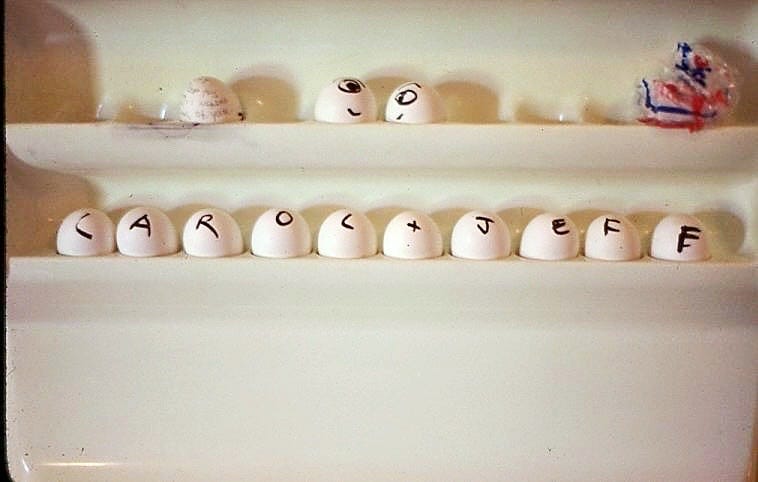
That is, someone who understood that the best way to prevent other people from eating our eggs was to write our names on them. (She wound up getting a PhD in Behavioral Neuroscience and animal communication…so presumably she knew something even then about how to inform other creatures about not consuming our hard-earned groceries.)

And she who helped me consume an entire 30 gallon bag of pot plant trimmings after I found it while cleaning out a mod once its Spring semester occupants had departed.
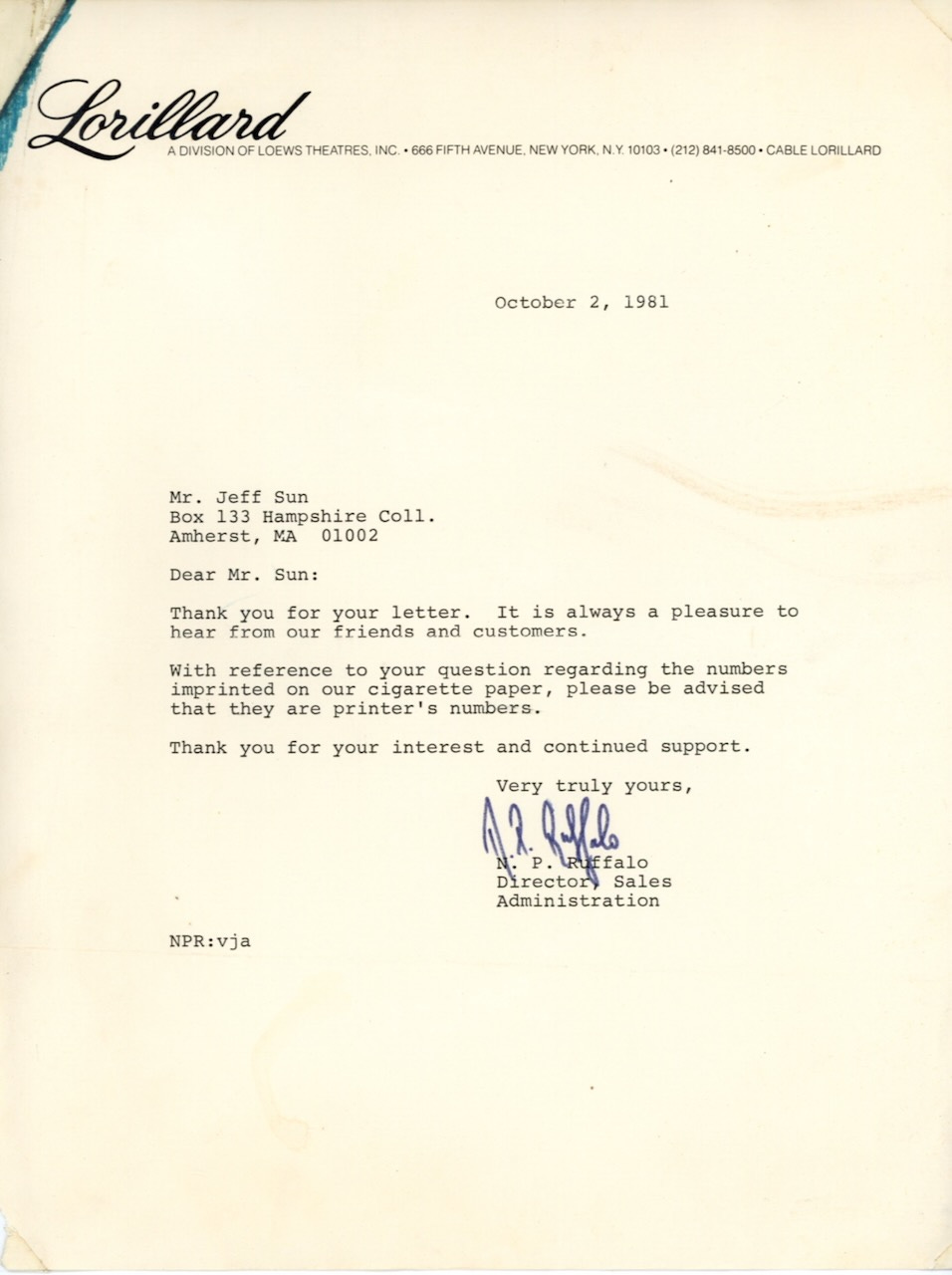
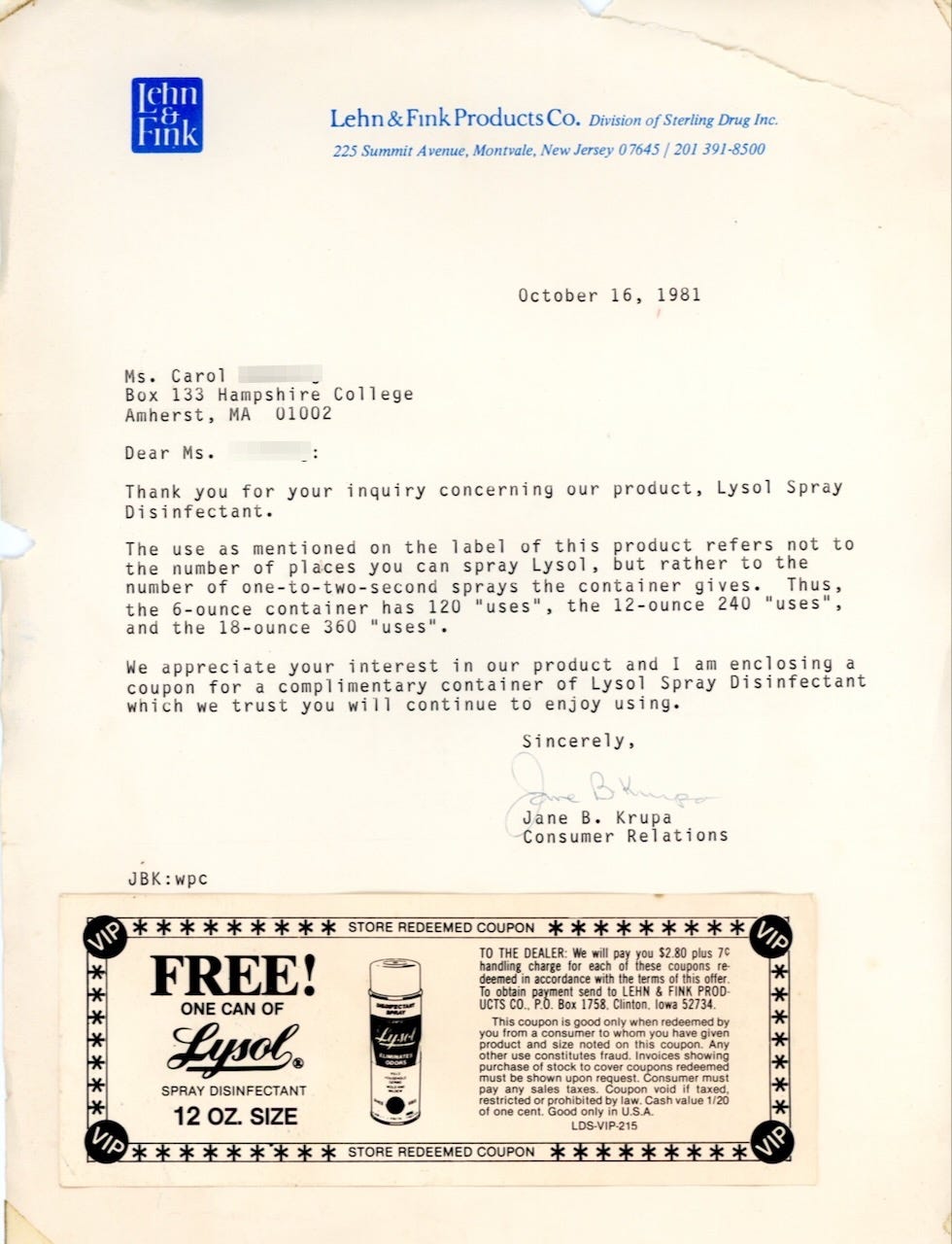
That was part of the inspiration (I’m sure you can figure that out) for a late-summer letter-writing campaign to various companies whose products we used, complimenting them on their goods, and then proceeding to ask entirely disingenuous questions just to see what kind of responses we might get.
It took a little while for us to get our replies, but we did get a few quite good ones.
We also found a lot of time that summer to just go riding around in the Buick. Once we made it as far as the very southern New Jersey Shore (SIC), but the details of most of that (aside from sleeping outdoors on the deck of a house that no longer exists and swimming in some very remarkable mud pits) have disappeared into the haze.
By all means, not everything has vanished into the haze. For some reason, I can still envision so many evenings just hanging out.
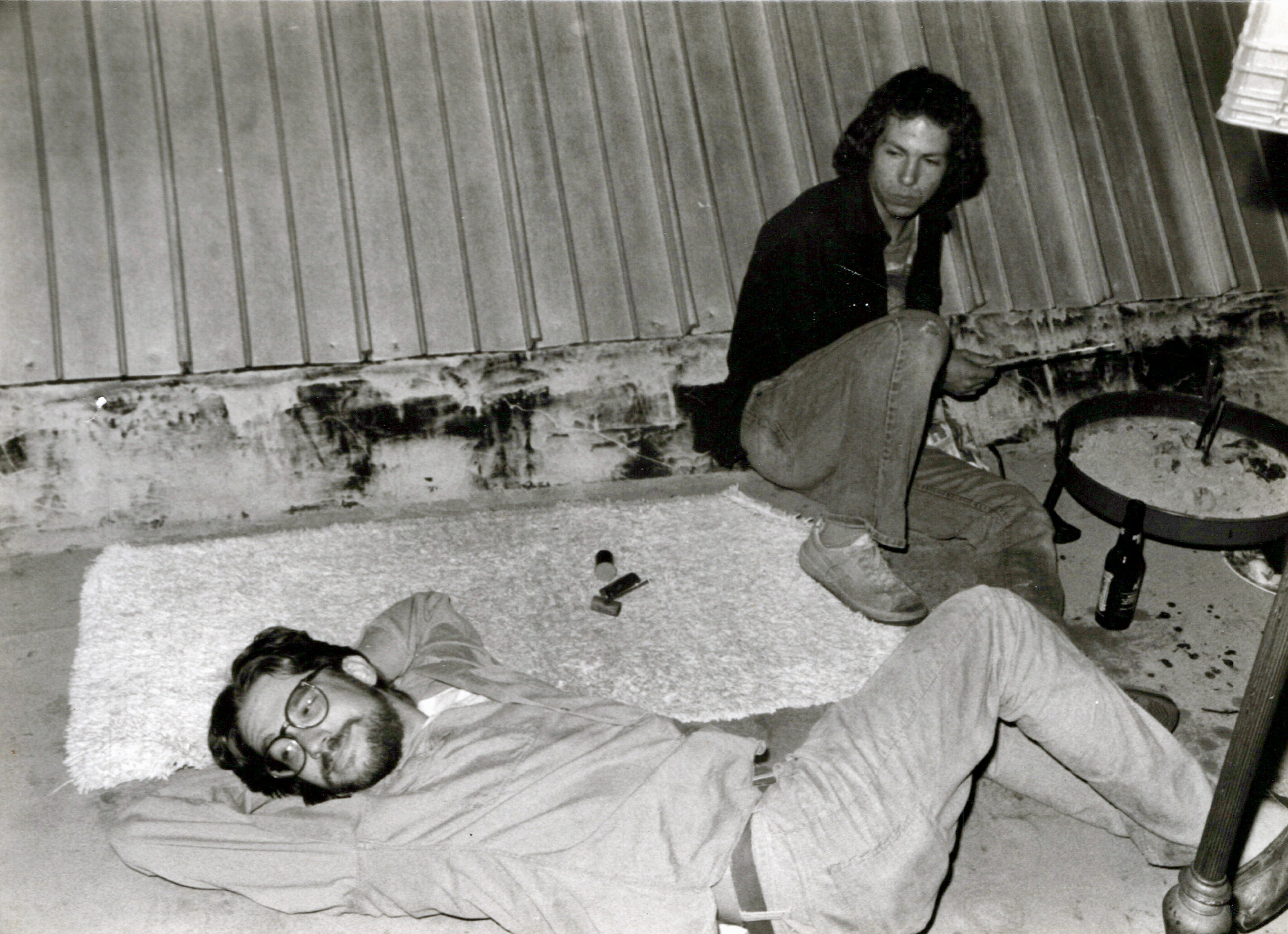
Here, as a residential assistant, I should have been more concerned with the charcoal grill on the roof than the weed. Neither was an issue as far as I was concerned.
We’re good.
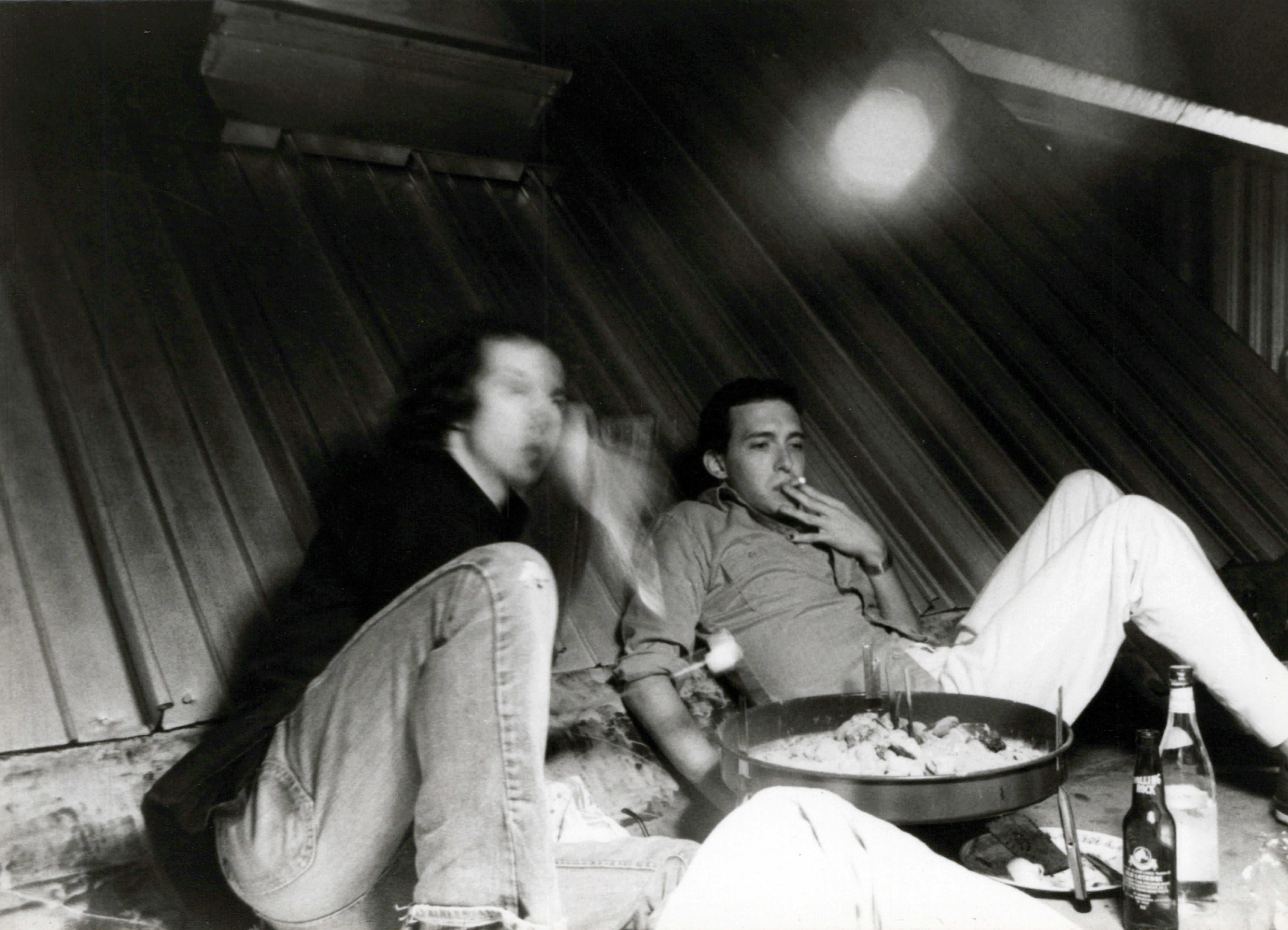
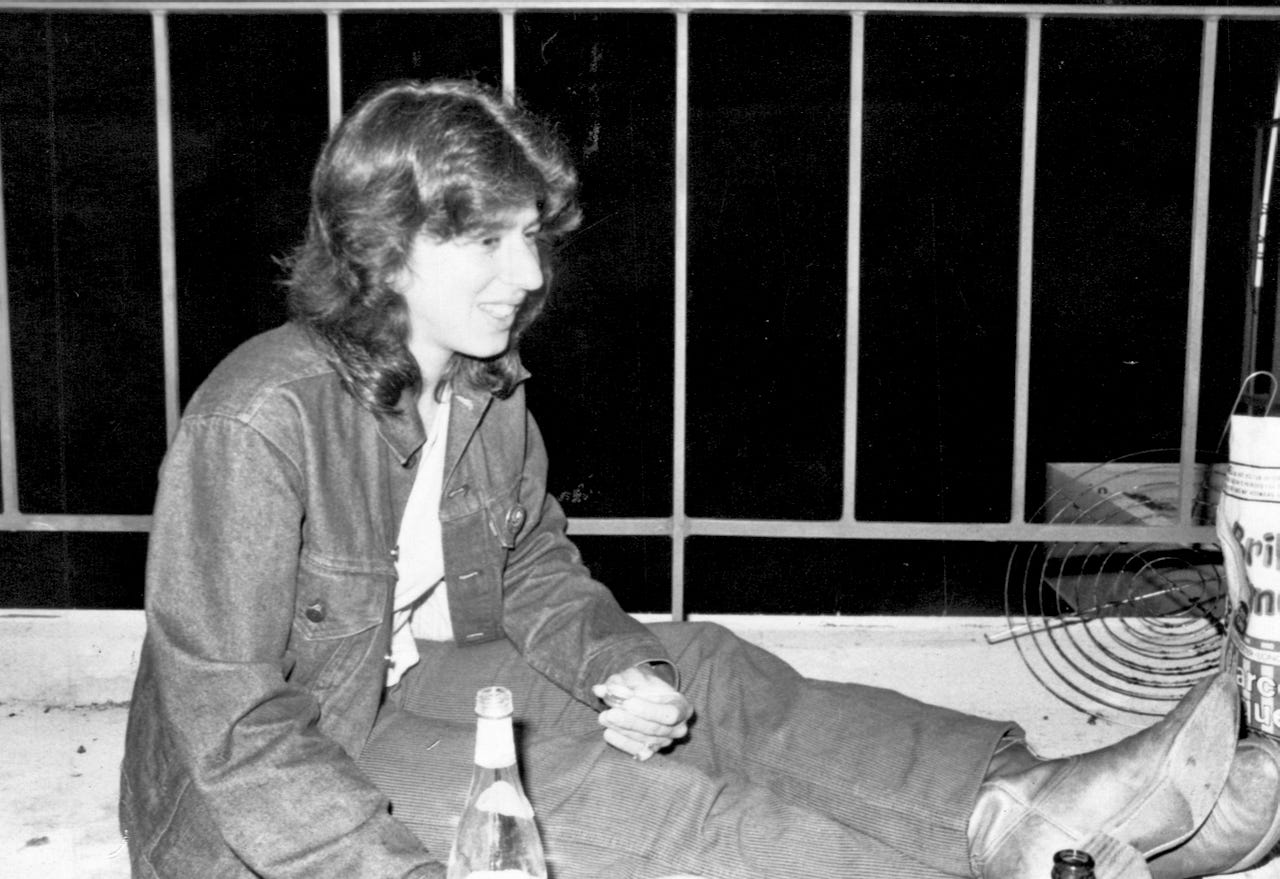
So yeah, that family thing went further than always making sure that the folks I lived with had groceries. It continued on in such a way that by my second year I became what in other schools is called a “resident assistant” (R.A.). At Hampshire where we always had to have a different noun for everything — and sometimes several different nouns for the same thing at once - we were called “Interns”. I don’t know why. Unless maybe the idea was that eventually we’d all be there long enough to turn into actual employees.
I’m positive that some students did eventually graduate (probably…) and become actual employees, I just don’t know who.
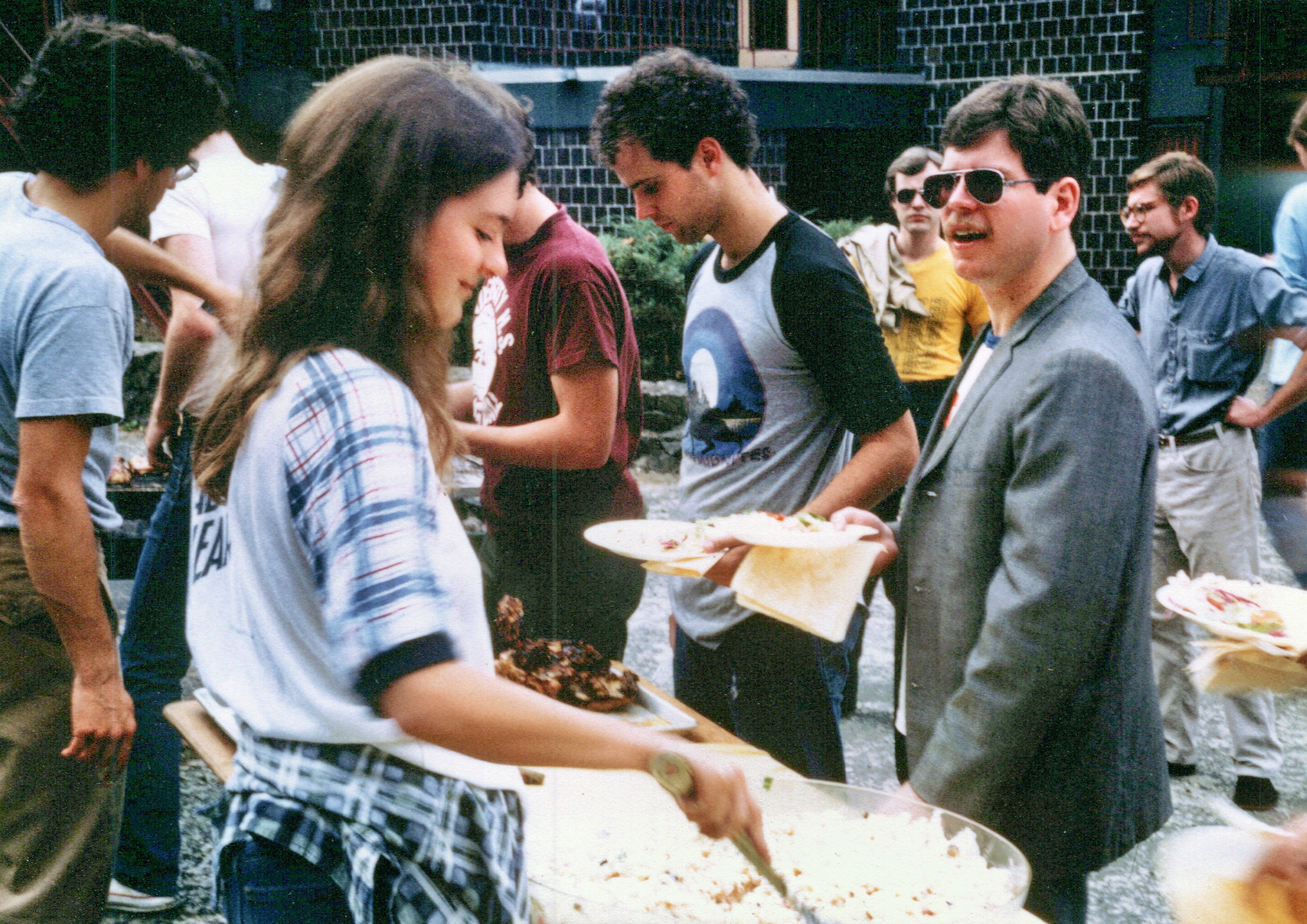
Interns lived among our fellow students/civilians and performed various good deeds for pay. We performed some bad deeds as well, but that’s a rabbit hole we don’t need to go down right now. In my housing complex, it seemed that a lot of what we did when not spending our time letting locked-out inebriated people into their rooms and handing out rolls of toilet paper (sometimes urgently at 2 or 3 o’clock in the morning) was organizing parties.
My housing complex was unique on campus for being built with an actual bar in its central quad. Back then, when the drinking age in Massachusetts was 18, campus bars were not a particularly far-fetched idea. Neighboring UMass Amherst had a legendary bar in its Campus Center. Hampshire had the Prescott Tavern.
Aside from being the backdrop to the numerous outdoor cookouts that we Interns organized, the Tavern also provided a spot to run a weekly film series. That was my job for the two years that I was an Intern. Beer, food, weird movies, what’s not to like?
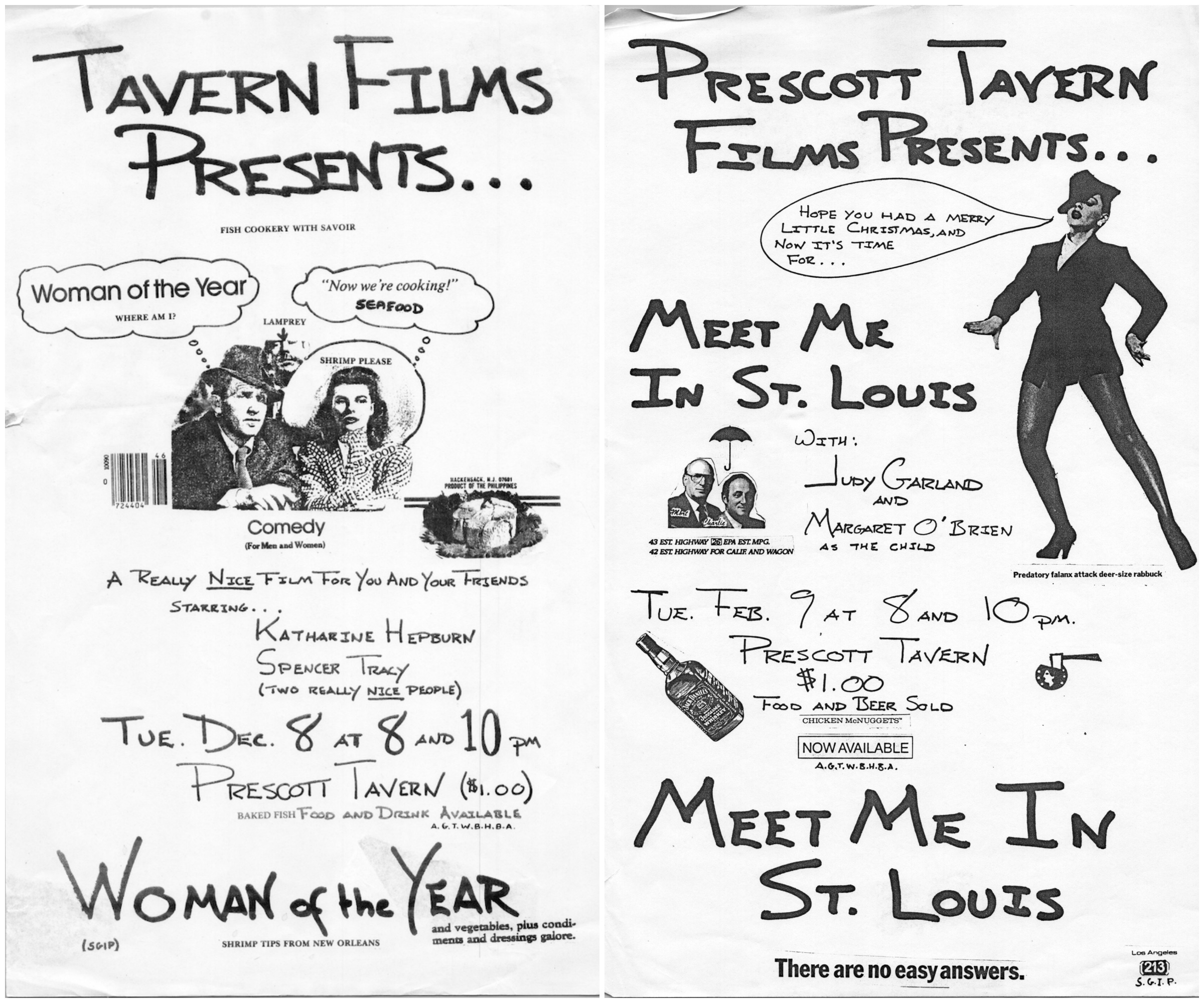
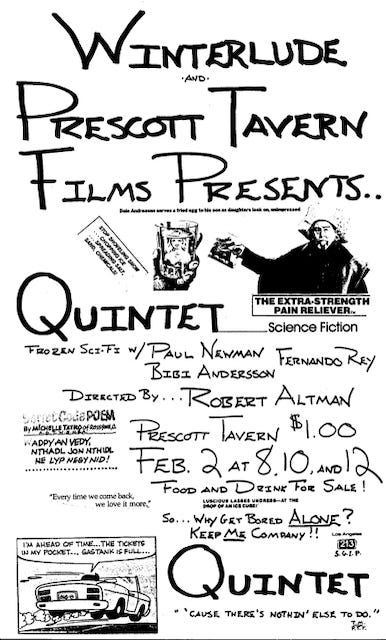
To be sure, not all of the films we chose to show were classic American things from the 1950s (although these were fun and well-attended). We also populated the series with a bunch of films that we were sure no one would want to see…as in the Hampshire ethos of the day that would absolutely have been the whole point. Unfortunately, no matter what we tried, people came.
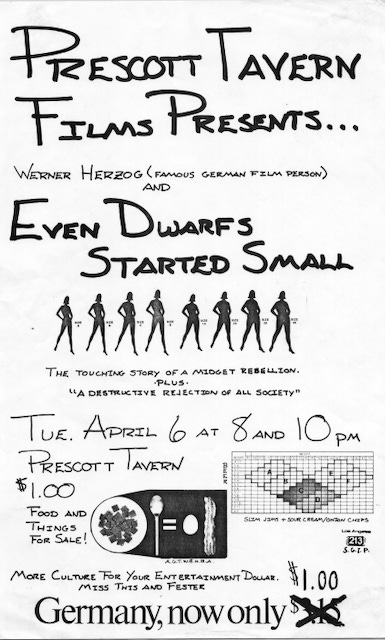
Maybe, in the bigger picture, what we Interns were mostly about is what nowadays is called “event planning”. That is, parties. I do recall that we got a lot of practice in that. And I’m not talking about Hampshire’s legendary and very well orchestrated/monitored by the Administration Halloween party. That is a whole other topic. Rather, some of the best parties were those individual groups of students planned themselves.
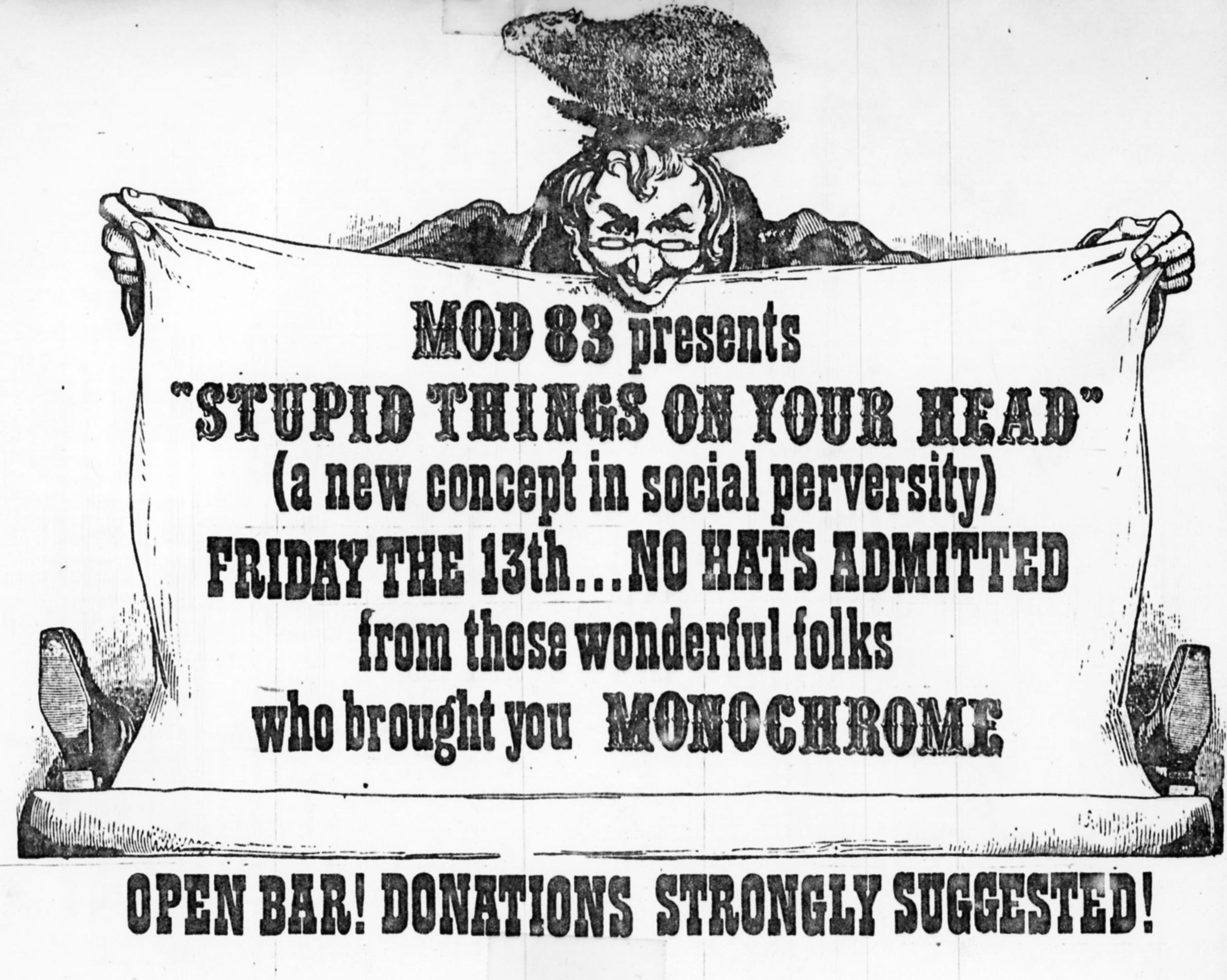
The lede photo for this article is from our “Stupid Things On Your Head” party. As the poster says, this was a follow-up activity to our “Monochrome” party (in the manner of Truman Capote’s Black and White Ball from 14 years earlier, because that’s just the sort of thing that my people would know about and studiously choose to replicate).
The following year, when I lived in a different mod, but with many of the same people (some of the people from the previous year had done that greener pastures thing and drifted off), the themed parties continued.
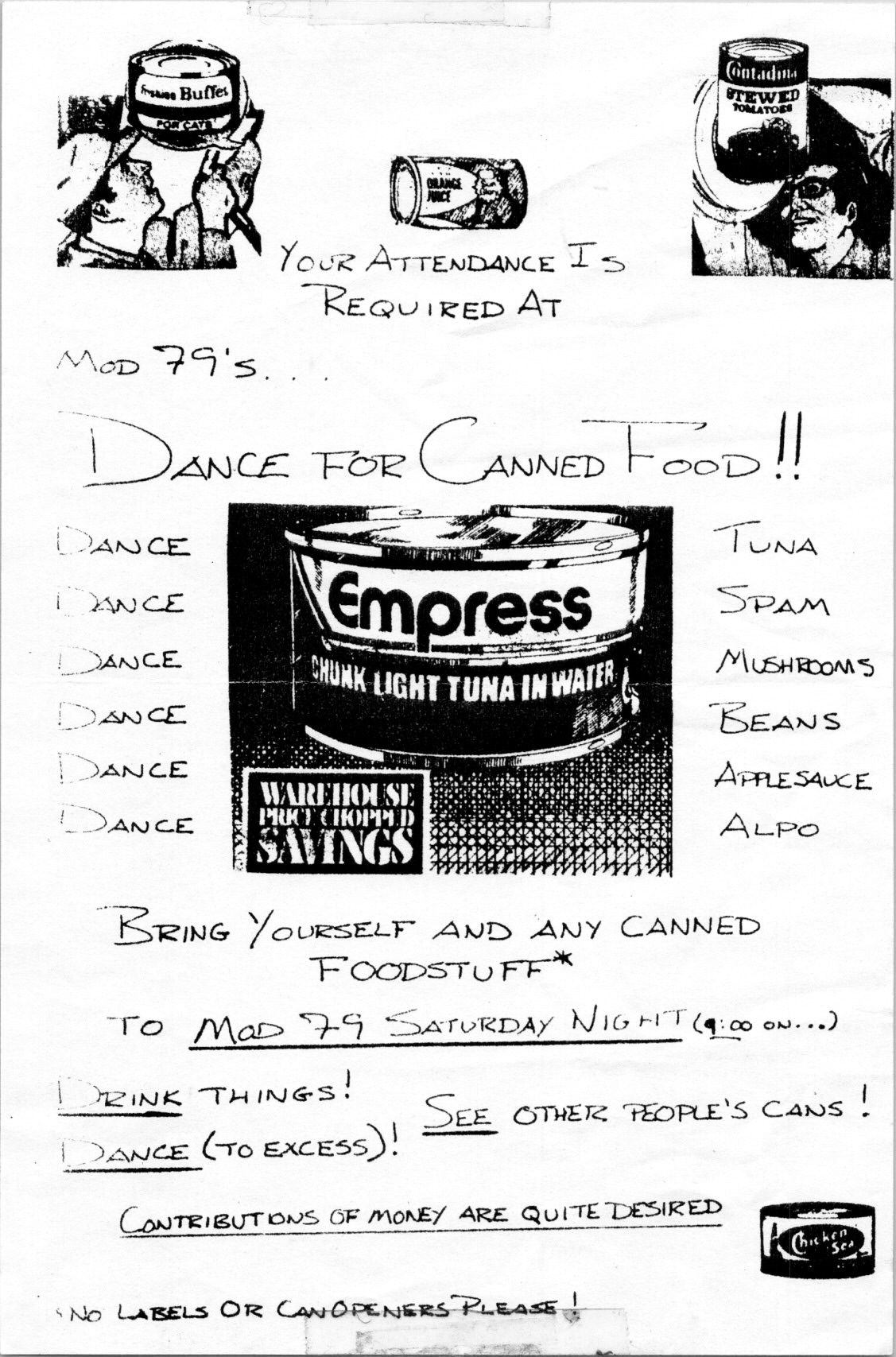
There was the memorable “Dance for Canned Food”…which I believe that we thought was a good idea so far as acquiring donated groceries. We mostly just wanted to see what kind of canned food would show up (and then to spend the rest of the semester planning our meals around whatever had been donated).
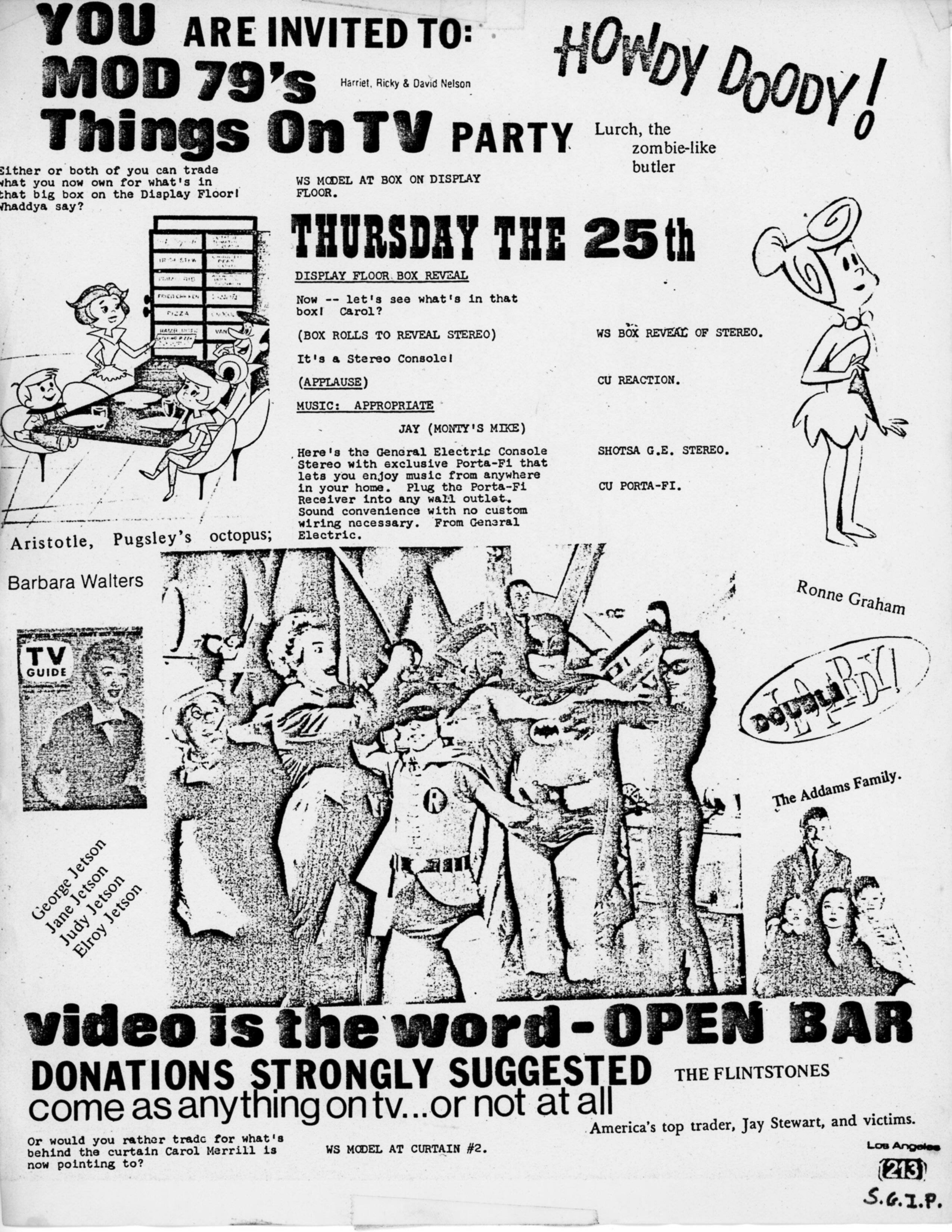
The “Things on TV” party must not have been much of a hit as I cannot recall it at all, despite apparently devoting more effort than usual in creating the poster.
On the other hand, maybe that means that it was the best one ever.
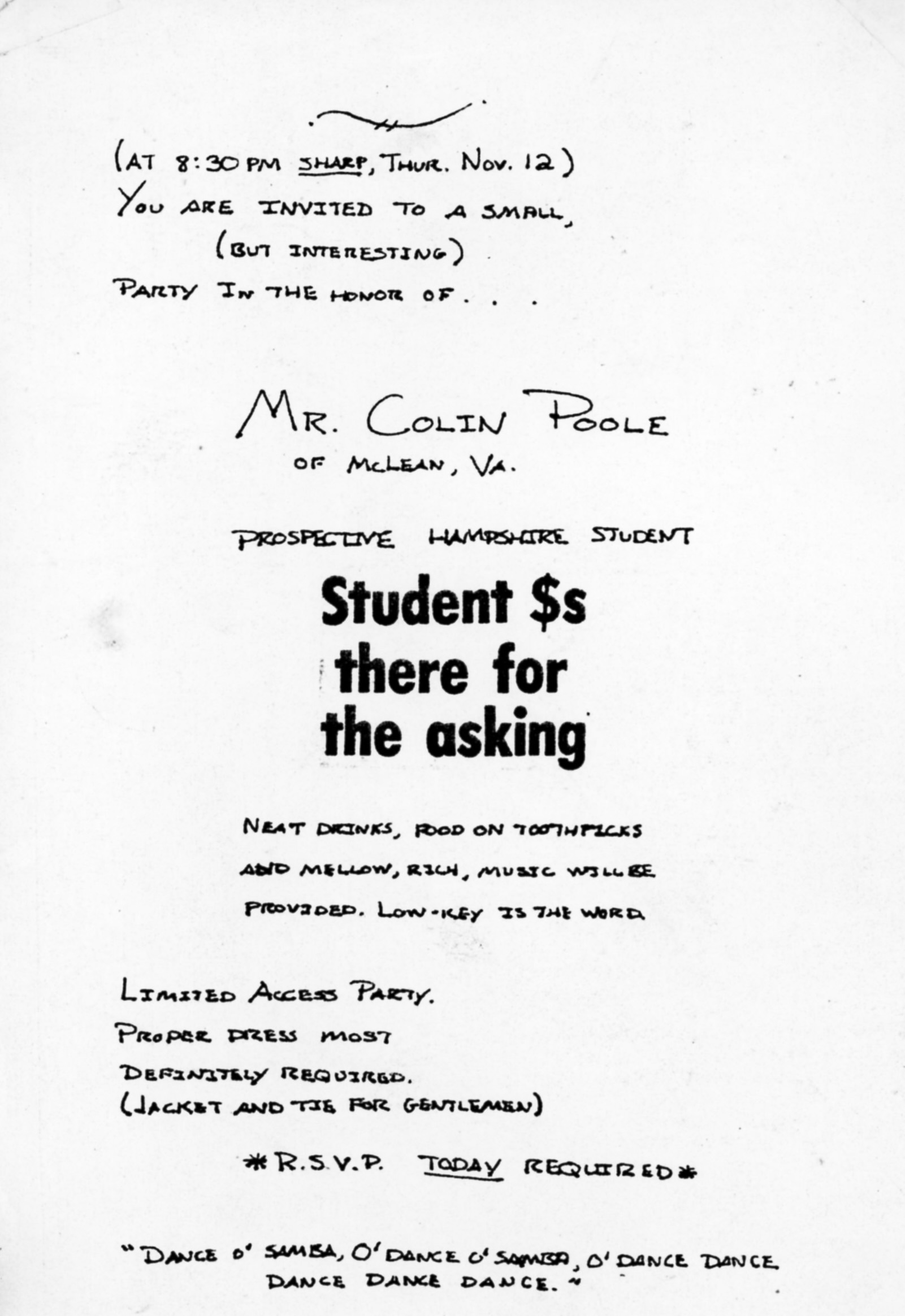
One from this era that I totally recall, and that speaks to the power of family in terms of supporting and moving forward with a clearly dubious idea (Yes, I was melding my newly founded concept of “my people” with the characteristically ill-considered ideas of my real birth family), was a dinner party we hosted for an entirely unsuspecting guest.
This was known at the time as “The Samba Party”. Vai, vai, vai, vai, vai. The entire thing was built around a campus visit by a prospective student who for reasons unknown wanted to spend a night on campus. I was charged by the Admissions office as the guy who would host this prospective (Colin Poole of McLean, VA). Naturally, once I informed my mod-mates of the impending event, they (and then I, of course) certainly could not leave it alone.
No, we had to organize a party that involved what the above poster says. We created something that approximated that scene in the Graduate where Mr. McGuire informed Benjamin that the future consisted of one word. Just one word. Plastics. Except at least some of us wanted to substitute that word with another….”Hampshire”
It’s doubtful that any of us got to that point, as the drugs would have been kicking in about then. Vai, vai, vai, vai, vai.
So I can’t recall if Colin ever got the appropriate message. Or any message at all. I’m pretty sure that he never actually enrolled (as he likely managed to pull one out of the fire and gain admission to Amherst College in the end).
Although I do worry that if only we’d been able to admit Colin, we might not be in the predicament that Hampshire is in now. You know, the butterfly effect. If only….

All photos by the author.
Enjoyed this so much, Jeff. Memories of my own experiences bubbled up! I also worked for the admissions office at Allegheny College. And gave tours—you guessed it, barefoot. Eventually I was told not to. Friends with a huge Buick-type vehicle were always appreciated! For trips to the grocery store and once-a-semester outings to the laundromat!
Thanks, Jeff. I remember being at the edge of your social life through our mutual friends. You seem to both be serious about your academic work and also have lots of energy for organizing, funny parties, etc. also a much belated thanks for a ride to the Cape in that big Buick.